for a sample to be truly random what must be true
What is a Random Sample?
A random sample is a sample that is chosen randomly. It could be more accurately called a randomly chosen sample. Random samples are used to avoid bias and other unwanted effects. Of form, it isn't quite every bit unproblematic every bit it seems: choosing a random sample isn't as simple as simply picking 100 people from ten,000 people. You have to exist sure that your random sample is truly random!
Note that the word "random" in random sample doesn't exactly fit the dictionary definition of the word. If you Google "define:random" and so you'll read that it ways:
fabricated, done, happening, or chosen without method or conscious decision.
"a random sample of 100 households"
It isn't truthful that a random sample is chosen "without method of conscious decision." Simple random sampling is one fashion to cull a random sample.
What is a Simple Random Sample?
A simple random sample is oft mentioned in elementary statistics classes, but information technology's actually one of the least used techniques. In theory, it'southward like shooting fish in a barrel to understand. However, in practice it's tough to perform.
Technically, a elementary random sample is a set up of n objects in a population of N objects where all possible samples are equally probable to happen. Hither's a basic example of how to get a unproblematic random sample: put 100 numbered bingo balls into a bowl (this is the population N). Select 10 balls from the bowl without looking (this is your sample due north). Note that information technology's of import not to look as you could (unknowingly) bias the sample. While the "lottery bowl" method tin piece of work fine for smaller populations, in reality you lot'll be dealing with much larger populations.
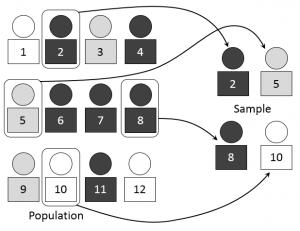
Simple random sampling of a sample "n" of three from a population "N" of 12. Prototype: Dan Kernler |Wikimedia Commons
Imagine the people illustrated in the image above are game pieces. Place the 12 game pieces in a bowl and (again, without looking) choose 3. This is unproblematic random sampling.

Image: CSUS.edu
A simple random sample is chosen in such a style that every set of individuals has an equal chance to be in the selected sample. It sounds easy, but SRS is often difficult to employ in surveys or experiments. In addition, information technology's very easy for bias to creep into samples obtained with elementary random sampling. Sometimes it's impossible (either financially or time-wise) to get a realistic sampling frame (the population from which the sample is to be chosen). For example, if you lot wanted to study all the adults in the U.Due south. who had high cholesterol, the listing would be practically impossible to get unless you surveyed every person in the land. Therefore other sampling methods would probably exist better suited to that particular experiment.
The simplest instance of SRS would be working with things like dice or cards — rolling the die or dealing cards from a deck can give you a elementary random sample. But in real life you're normally dealing with people, not cards, and that tin be a challenge.
How to Perform Simple Random Sampling: Example
A larger population might be "All people who take had strokes in the United States." That list of participants would be extremely difficult to obtain. Where would you go such a listing in the first place? Yous could contact individual hospitals (of which there are thousands and thousands…) and ask for a list of patients (would they even supply you with that information? If yous could somehow obtain this list then you will end upwards with a list of 800,000 people which yous and so take to put into a "bowl" of some sort and choose random people for your sample. This type of state of affairs is the type of real-life state of affairs you'll come beyond and is what makes getting a simple random sample and so hard to undertake.
Example question: Outline the steps for obtaining a simple random sample for outcomes of strokes in U.Due south. trauma hospitals.
Stride 1: Make a list of all the trauma hospitals in the U.Southward. (there are several hundred: the CDC keeps a list).
Step 2: Assign a sequential number to each trauma center (1,2,iii…n). This is your sampling frame (the list from which you draw your simple random sample).
Stride iii: Figure out what your sample size is going to be. Run into: (Sample size) (how to find one).
Pace 4: Apply a random number generator to select the sample, using your sampling frame (population size) from Pace two and your sample size from Step three. For instance, if your sample size is 50 and your population is 500, generate fifty random numbers between one and 500.
Alert: If y'all compromise (say, past not including ALL trauma centers in your sampling frame), it could open your results to bias.
Uncomplicated Random Sample vs. Random Sample
A uncomplicated random sample is similar to a random sample. The difference betwixt the two is that with a simple random sample, each object in the population has an equal chance of beingness chosen. With random sampling, each object does not necessarily have an equal chance of being called. Diff probability sampling isn't unremarkably addressed in basic statistics courses.
Square Root Biased Sampling
Square root biased sampling isn't a technique that's widely used, and it'due south doubtful that you'll be tested on it in any elementary statistics or AP statistics grade. That said information technology is an interesting technique that attempts to address the problem of profiling at airdrome screenings.
I get selected for "actress screening" every time I travel by plane. I'thou guessing it'southward because I take dreadlocks, simply I really have no idea. All I know is something near me is causing security to pull me aside every time. Every bit well as information technology non being fair, it's besides taking upward resources that could be meliorate spent looking at other people who might actually be up to terrorist activities!
Statisticians strive to choose random people for surveys and experiments. This random sampling doesn't happen at drome screenings, presumably because people who "look" a certain mode are more likely to exist terrorists. This is a problem William H. Press attempts to address with square root biased sampling. He states:
"…resources are wasted on the repeated screening of higher probability, only innocent, individuals."
In other words, profiling by ethnicity, having the aforementioned name equally someone on a watch list (or in my case, having dreadlocks) isn't a mathematically sound fashion to catch a terrorist.
Foursquare root biased sampling adds simple random sampling to profiling. Simple random sampling is where individuals are called completely past chance from a population. The improver of SRS increases the gamble a guilty person will be found. It should also mean innocent travelers are more than likely to cakewalk through security. The organisation works by assigning the same profiling. Instead of a profiled passenger being selected for screening every time, they may be pulled aside less oft. For example, if a person is 10 times more likely to be a terrorist, the current organization would pull them bated x times more often than a not-profiled passenger. This basically means every time that profiled person travels they will exist pulled aside. The improver of SRS means that the passenger will just be pulled aside 3 times every bit often.
Other ways to get a random sample:
Stratified random sample
Single-stage cluster sampling
References
Agresti A. (1990) Categorical Data Analysis. John Wiley and Sons, New York.
Dodge, Y. (2008). The Concise Encyclopedia of Statistics. Springer.
Gonick, L. (1993). The Cartoon Guide to Statistics. HarperPerennial.
William Press.
---------------------------------------------------------------------------
Demand help with a homework or examination question? With Chegg Study, you can go step-by-footstep solutions to your questions from an expert in the field. Your first 30 minutes with a Chegg tutor is complimentary!
Comments? Need to post a correction? Delight postal service a comment on our Facebook page .
campbellmepheculd.blogspot.com
Source: https://www.statisticshowto.com/probability-and-statistics/statistics-definitions/simple-random-sample/
0 Response to "for a sample to be truly random what must be true"
إرسال تعليق